Speed Writing #3 – Sleepy Traveler

The thing about traveling solo is that you never know who you’re going to meet.  Meegan’s parents perpetually expected her to run into rapists and murderers, compliments of hyperbolic media.  She’d encountered some really nice folks and a few incredibly rude ones, so really, just people being people.  She expected this trip to be a lot of the same.

She hadn’t been to Minnesota in a couple of years, not since the meeting where she’d landed these particular clients.  Most of the time she was able to work with them over the phone or online, but they had a new CEO, and he was the sort who liked to meet everyone in person once.  All that being the case, she’d decided to tack a little vacation on to her trip.  Her co-workers assumed she would spend most of her time at the Mall of America, but she’d seen it on her last trip, and it was enough to know it wasn’t really her thing.  She’d heard there were really nice trails both in and near the Twin Cities, and that was what she was really looking forward to.

Continue reading Speed Writing #3 – Sleepy Traveler

Change of Venue

Everyone needs a little change of pace now and again, and it’s doubly true for an artist. While many of us may find some measure of inspiration in our daily lives, there is little more energizing than a change of setting. Away from our usual locale, we may find ourselves less hampered by intrusions and extraneous activities and more able to give ourselves over to our muse. In the end, a trip away from home may be just what the doctor ordered to get a writer back on track and into a productive mindset.

Even as a child I enjoyed writing outside. While I can get a bit wordy and floral in my descriptions, I have always found nature to be a bit of a natural boost to my creativity.

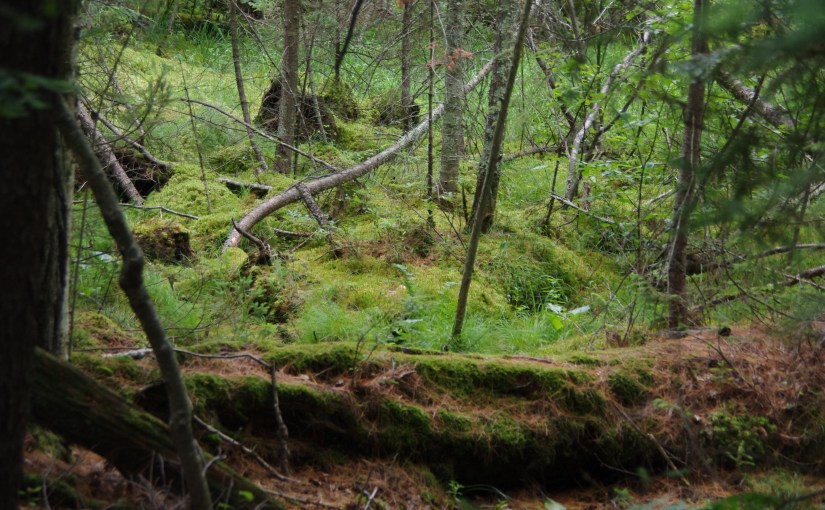
I’m currently sitting at the base of an old cedar in a grove of similar trees. I’m surrounded by wetland. The combination of water and layers of decomposing organic material makes the ground just soft enough to give a little under my feet. The mosquitoes have finally forgotten I’m here. Ants and daddy-longlegs are running around me in their usual scurry of daily life. In the distance I can hear the calls of a variety of birds, some chirp, others whistle, and the annoying ones squawk. When the breeze blows through, I can smell the lake and the pine turpines. When it’s calm, I can smell the damp earth and rotting pine needles. I saw two deer on my walk here. I am aware of but can ignore the occasional buzz of a motorboat speeding across the nearby lake.

In the past four days my productivity has increased dramatically. I wrote a short story in a single sitting, and started a second new story as well. I’ve edited two older shorts that I’ve been hanging on to for months. Sometimes editing is more difficult than creating, and the writer can face it with a foreboding sense of dread. There’s no one here to bother me, so I can work undisturbed in a place that motivates and inspires me.

Every artist runs into disruptions and life issues that compete with their art for time. It’s likely the single most aggravating aspect of being an artist. No one will let you alone to do your thing. Sometimes getting away from it all is not only a solution, but a necessity. How are we to succeed if we can’t get any work done? If we’re not creating something, we’re generally an unhappy lot. I know I don’t sleep well if I haven’t been writing. The ideas keep me awake. It’s in the best interest of my sanity, and my family’s happiness, that I get the chance to prove to myself every now and again, that I really am a writer, and I really would accomplish a lot if I didn’t have to be involved with the rest of the world.

For some it is the fast pace of a city, for others it’s the calm of wilderness, but for most of us, any change of venue is enough to get us going. When you start to get frustrated because you’re not doing the things you most want, it may be time to take a break from the rest of the world. Leave the dog with family, trade babysitting with the neighbors, be selfish and find the place that helps you write. And never forget that it’s there.

Writer Brain… Again

Brain: Pssst!

Me: Hubba wuh?

Brain (eagerly): Check out this killer opening line–

Me: Stop that!  I’m already up to my eyeballs in the not-so-short story you tricked me into “briefly” setting aside the novel for.

Brain (baffled): So?

Me: And I’m currently stuck in the middle of an overgrown patch of raspberries, getting savaged by insects.

Brain (still baffled): And your point is what, exactly?

Me: I don’t have anything to write with.  I’m busy!

Brain: You could carve it into that rhubarb leaf over there, with your fingernail… or a stick.

Me: That’s not rhubarb.

Brain: It’ll literally take you twenty seconds.

Me: You’ve obviously never tried etching an opening line into a leaf of burdok.

Brain (seriously): I’m beginning to think you don’t really appreciate me.

Me: <eyeroll>

Brain: I give everything to you.  And you take it all, but you can’t spare thirty seconds for me when I need you.

Me: You’re getting a bit melodramatic, don’t you think?

Brain: Actually, I think you’re selfish.  And I haven’t had a vacation in a while.  And maybe I should go find someone who wants me around!

Me: Oh, come on.  You know that’s not true–

Brain: Just you wait.  You’ll come looking for me, and I won’t be there.

Me (resigned): *sigh*  I’m sorry, all right?  I didn’t mean it.  I’m a horrible person, and I don’t deserve to bask in all your awesome.

Brain: True.

Me: Please don’t go.

Brain: <dramatic pause> Fine.  I’ll stay.  This time.

Me: Thank you.

Brain: So about that opening line…


Check out all the Writer Brain shenanigans in reverse chronological order here.

Graphic Novels for the Younger Crowd

Graphic novels are a ton of fun to read, even if you’re an accomplished reader, and they can make some stories accessible and appealing to struggling readers.  These are my top recommendations for graphic novels for folks reading in the classic young adult range. These have a level of on screen violence and physical relationships that you’d see on the television or in a PG film. I only list the first book in a series, because it’s a good idea to make sure you like book one before picking up all of them.

Author’s name is at the top. 
Book title (only the first in a series will be listed)
– Notes or description preceded by a hyphen


Vera Brogsol
Be Prepared
– Autobiography of a Russian-American summer camp experience.  The main character is the daughter of a Russian immigrant, and she has heard about the wonders of camp for years.  When she finally gets to go to Russian summer camp, it’s not quite as she expected. How will she survive? How will she make friends

Continue reading Graphic Novels for the Younger Crowd

Adaptation

Artistic individuals often like to make the creative process more mysterious and confusing than it truly is. Many writers, for example, insist that certain conditions must be met in order to write. These may include silence, a locked door, a special location, a specific frame of mind, or even a well-rehearsed ritual.

Ask these sorts of writers to change their difficult ways, and they will vehemently insist that modification is impossible.

While it is true that our own inhibitions may color our writing techniques, those who are truly driven will adjust, should the need arise. The human species has an incredible ability to adapt to nearly anything. We can be found living in the coldest and hottest places on earth. We have figured out how to survive in the driest and wettest climates. We’re quite capable of compensating for our weaknesses, physical, mental, or otherwise. Everyone has heard at least one story of a physically handicapped individual overcoming perceived insurmountable odds. Likewise, we have all heard of at least one dyslexic who somehow managed to make it through high school without anyone ever knowing they were different.

We are resilient, although many of us seem think we are incredibly fragile. Our evolution and history have been complicated and dangerous, and it is our resilience and ability to adapt that have gotten us where we are today.

Change is difficult, and to be honest, most writers won’t do it without good reason. Really good reason. We like our habits, our rituals, and our crutches, although we don’t truly need them. They are like a comfortable old armchair or a favorite pair of jeans. They are the kind of possession that can never be stolen, however, they can be taken away.

I used to be the kind of writer who did everything with pen and paper. When I first discovered the typewriter, I realized that my writing could go quicker and be more legible if I was willing to adapt. I’m a fast writer, the kind who always comes back later to edit, so although typing was a complicated process I was willing to persevere. The word processor was really only a minor modification to my writing technique, making rewrites a lot easier. While the computer confined me to one location, the editing possibilities made it well worth the modification. I still picked up my pen and pad for the times I chose to write away for my computer.

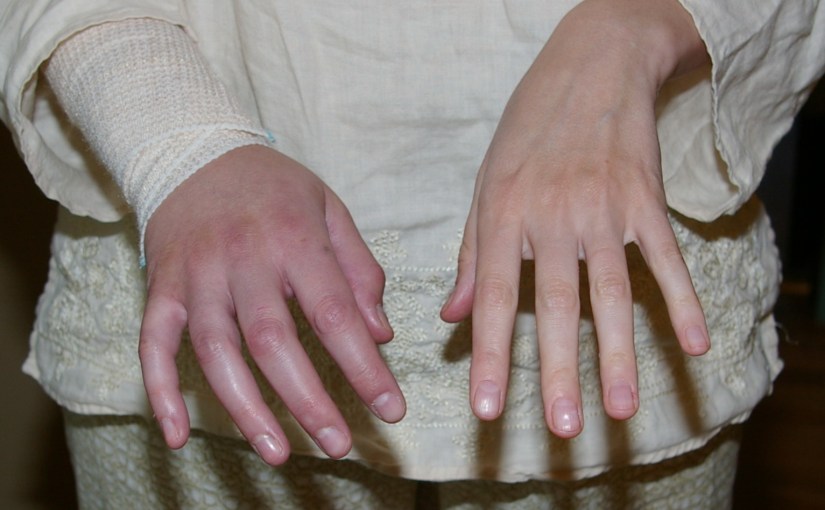
When I developed tendinosis, I was essentially forced to put down my pen permanently. I learned to type while wearing splints and straps, which greatly hampered by hand mobility. I learned to keep my keyboard in my lap. I also found out that taking breaks was a necessity if I wanted to be able to tie my shoes after day of writing. I still like to go on location and leave the confines of my cramped cluttered computer room, and spent many years unable to do so. As soon as I could afford to do so, I invested in a laptop which essentially had no other purpose than to take me places to people watch, world build, and write when away from home.

Eventually, further modifications to my writing technique were required. Between an office job and writing, I was doing more typing than my arms could handle, even with splints and breaks. A writer at heart, I have never been a particularly good speaker. I could barely type quickly enough to keep up with my mind, and my voice lagged woefully behind. Although I had been aware of voice recognition software since the mid-1990s, I had no particular interest in using it for quite some time. It was inaccurate. It wasn’t my “style.” I didn’t have a computer powerful enough to run it anyway. But these were all excuses. I’m a slave to my muse, and have learned to adapt. Starting in 2000 voice recognition became my primary method for writing initial drafts.

For a while these necessary adaptations resulted in my writing being more restricted. It could only happen in the same room, to avoid altering the acoustics and messing with the software.  I had to be alone or it felt like someone was reading over my shoulder. With time and practice, dictation came easier, and I no longer need to banish all living beings from the room, floor, or house. Changing my methods resulted in better control of my tendonosis which has made it possible for me to do a little handwriting or typing on a tablet if I want to work off-site. The path wasn’t easy, and I often resented the need for it, but in the end, it’s made me a better writer and stronger person.

This article was written using Dragon NaturallySpeaking and revised using a split floating keyboard once known as Interfaces by Cramer.

Autumn

It was quiet in the big woods these days. From atop her great pine, Zenza could see over most of her neighboring trees. Holding two branches for support, she leaned out, closed her eyes, and took a deep breath. She smiled as fallen leaves, wet from a recent rain, filled her senses.

“Don’t do it!”

The horrified shout broke her out of her reverie and she looked around for the source.

“For the love of maple sugar, don’t do it!”

She knew that voice. She looked down into a young maple that had barely begun to change color despite the season. Darja stood on one of the uppermost branches and, even from the distance, Zenza could see fear on the girl’s face.

“Oh Zenza, it’s only autumn.”

“What are you talking about?” she demanded. Why did she always have to get the nervous neophytes?

“It’s not worth killing yourself,” she said gently. “You’d be missed far too much.”

Continue reading Autumn

Resources for Speculative Fiction Writers

At Marscon 2018, I moderated a panel discussion on resources for speculative fiction writers.  I’ll share a bit of our discussion here to tide you over as I prepare several posts (which will all be tagged and available under the resources link in the main menu) with links to tools and essays that may be of use to writers (especially those who write fantasy, science fiction, and horror).

The questions below are some I asked my panelists.  The answers are a summary of the collective discussion.  Huge thanks to Kathryn SullivanNaomi Kritzer, and Ozgur K. Sahin, who are always excellent to talk shop with. 

Continue reading Resources for Speculative Fiction Writers

Book Categories Marketed to Younger Readers

I’ve prepared some book recommendation lists (finally), and I think it would be handy for folks to have this information for reference.  These are the rough definitions used in the marketing and packaging of books intended for a younger audience.  Keep in mind, some publishers and book stores may be more liberal with these definitions, and these do change over time; some folks splinter these groups even further, and that these designations are subjective as heck.

Continue reading Book Categories Marketed to Younger Readers

Speed Writing #2 – How to Lose Your Dragonette

The cool evening air was a relief after a full day stuck inside a warehouse with sketchy air conditioning.  I pushed open the heavy glass door to the balcony, and stood there for a moment, just breathing.

 A birdlike shriek called my attention back into my apartment.  I turned to see Spark pouncing around his dish, his usual a pre-dinner performance.  He paused and turned his yellow eyes in my direction before spreading his leathery wings and flapping to the counter top where he knew he didn’t belong.

 “Hey!“ I chastised.  “Get down from there.  This is not a self-serve buffet.”

 He let out a protest, but settled all four feet onto the green counter, as if to inform me that he’d feed himself if I didn’t get on with it.  Dragons may not be able to speak our language, but they sure as hell could communicate.  And they were smart.

 “All right, all right.“  I jogged over to prepare his dinner.  “You’ve made your point, you crazy little reptile.”

Continue reading Speed Writing #2 – How to Lose Your Dragonette

Casting Call

Without characters you have no story.  They function like objects in English language.  Without them we simply have adjectives and adverbs, and the occasional gerund, verbing about in a field of pretty flowers, or a city, or on a spaceship, or another planet.  Character development can mean the difference between the reader not finishing a story and thoroughly enjoying it.  

The keystone of any character, protagonist, antagonist, primary, secondary, or cameo, is that they feel real.  If your character has the depth of a cardboard cutout, your readers aren’t going to invest in their success, struggle, failure, or demise.  Physical description, personality, speech characteristics, back story, flaws and mannerisms are all elements that help make your character come alive on the page; any of these can be your starting point.

Description
To write good description, you’ll need some sort of picture (mental or otherwise) of the character.  If you don’t know what your character looks like, how will your reader?  Using real people as models can help when you’re in a bind.  If you have a vague idea, try doing an image search online with the characteristics you do know (brown eyed man, tall woman, traditional dreadlocks, etc) and see if you find some people who can help you flesh out your character’s physical appearance.  An image search for animals and mythical beasts can be helpful in the same way if your characters aren’t human.

Personality
Some writers feel compelled to complete complex worksheets and essays prior to starting a story.  If this works for you, it’s definitely an option, but it’s a lot of work, and it’s not necessary for every character.  You want a general feel for your characters’ personalities, but you don’t have to figure out their Meyers-Briggs placement or write lifeboat problem essays from their perspective. In the first draft, it’s a good idea to be somewhat flexible on personalities in case you need to modify things a bit for the story to work.  I find my characters’ personalities develop the more I write them.

Dialogue and Speech
How a character talks can tell the reader a great deal.  Does the character favor any specific words or phrases?  Are they using regional slang, oaths or incantations?  The types of words we choose can color the opinions and biases of the characters we create.  They also hint at the character’s past and give hints about the world. The dialogue of each character should feel like something they would say.  This doesn’t mean you have to make super specific speech patterns for each character, because that’s not how we talk in the real world.  However, you should pick words this character would use, and build their sentence structure to match their personality, education, and background.

Back Story
Believable characters generally do not spring fully-formed from the writer’s head to the paper like Athena from Zeus.  Good characters have experiences that made them who they are at the time of the story. I’m definitely not encouraging you to write a whole detailed novel version of their back story (this only becomes a never-ending backward trip through time), but you should know the basics, and perhaps have some key events in mind.  It’s noticeable when a writer knows more about the character than appears on the page; the story feels richer and the characters are much more dynamic and real. Back story includes everything in the character’s life that happened before they showed up in the story.  A character’s past will influence their fears, hopes, speech patterns, and biases.  Some pieces will be critical to the story, but others will just add flavor.  For most characters, you just need a rough idea of where they’ve come from and why they’re the way they are.

Flaws
Characters who are too perfect are boring.  We can’t relate to them, and their conflicts and victories are dull when compared to characters who make mistakes and have room for growth.  I have a short essay that goes deeper into character flaws, so I won’t belabor it here.

Mannerisms
These are the things that seem small, but add so much to making your characters feel real.  How does this character act when they are excited, sad, or angry?  While some characters may have some of the same reactions, they shouldn’t all respond identically all the time, unless they’re robots.  There are a number of ways your character could fidget to display embarrassment or boredom.  These are the little things you see in your friends and family while waiting at the doctor’s office or riding the bus.  Knee bouncing, hair twirling, nail biting, adjusting glasses, pushing sleeves up and down, lip biting, squinting, and slouching are all examples of things your characters can be doing.  Better yet if these show up in small two to five word additions to dialogue tags or narration.


Once your characters have reached a point where you’re happy with how they feel and look on the page, it’s a good idea to record the essential bits somewhere.  This is especially useful if you’re working on a lengthy series or if you may have to set the story aside for long periods of time.  This cheat sheet can get you back into your characters’ heads, preventing jarring out-of-character actions. While character development is essential to any story, with less verbose versions required for shorter stories, don’t get so carried away that you forget such things as plot, world development, description, dialogue, and voice.  It’s been known to happen, even to the best of us.