Accidental Magic – Sneaking Off – Part 2

<<< Go back to Part 1


The cabin had been quiet for a long time.  Laura pulled on the dark clothes she’d stuffed under her pillow before going to bed.  She pushed aside her blankets and slipped off her bunk.  She crouched there, her bare feet sticking to the floor and her shoulder level with her mattress, and listened.  Over the pounding of her heart, she could hear the three younger girls breathing, but that was all.  She reached under the bed for her shoes and socks, but carried them as she took baby steps toward the door.

She made it to the hallway without bumping into anything.  She took a slow breath and tried to relax.  She’d never woken anyone up while going to the bathroom.  Why was she worried about it now?  And why did everything seem so loud?  She crept to the couch.  Kaveh looked like he was asleep, and she was half tempted to go back to bed and forget about the whole thing.  She could say she’d fallen asleep. But then he would think she was a wimp.  Besides, how else would she find out what happened at magic camp?  As she reached for his shoulder, he rolled over and looked up at her.

Continue reading Accidental Magic – Sneaking Off – Part 2

Accidental Magic – Sneaking Off – Part 1

The gravel crunched under Laura’s feet as she crossed the road to the old logging trail.  Faint shadows of mist clung to the low spots.  The trees were spread out, so there was plenty of light, and the area had been logged out in the past, so there were no enormous trees.  Her passage startled a Broken Window bird, who crashed and clinked at her as it sought a higher branch.  The grass was long and thick, and Laura’s canvas sneakers were quickly soaked.

Before swapping charms yesterday, Laura and Kaveh found a spot in the woods, where they could practice without being seen.  He’d said they should practice magic in preparation for school, but it was such a secret she suspected they weren’t supposed to be doing it by themselves. Instead of deterring her, it made their trade more exciting.

Continue reading Accidental Magic – Sneaking Off – Part 1

Smutty Writer Brain – Take 2

Brain: Hey!  Check out all those nice words you wrote.

Me (vaguely disgruntled): Yes.  They are lovely.  But seriously, there’s no plot, there’s no way to wrap this up, and every time I look at it, I think of things to add.

Brain (proudly): Yeah.  I know.

Me (exasperated): It’s nearly six thousand words of graphic sex.  Seriously, who needs this?

Brain: The correct question is, who doesn’t?  Well, other than ace or sex-repulsed folks, of course.

Me: What am I supposed to do with this?  There are no speculative elements.  This is completely outside my genre range.

Brain: Does that really matter?

Me: What do you mean?

Brain: Did you enjoy writing it?  

Me: Yeah.  I mean… it’s words, and you know how I love words.

Brain (sarcastically): Sure.  And it had nothing to do with the content.

Me: Errr.

Brain: It doesn’t matter if you don’t market it or sell it.  What matters is that you enjoyed the process.

Me: Oh.  Yeah.  I guess you’re right.

Brain: You don’t grow or improve if you don’t try new things once in a while.

Me (reluctantly): True.

Brain: Great.  Now here, I have this lovely ending for you to put in.  You’ll see it actually wraps things together quite nicely, making it appear as though there was a planned plot from the get-go.

Me (blinking in surprise):  It’s so… fluffy.  And sweet.

Brain (proudly): Yeah.  I know.  You’re such a sucker for happy endings.


You can enjoy the entire Writer Brain adventure in chronological order here, or tap the #writer brain tag to read it in reverse chronological order. 

A Peek Into Indie Writer World – Part II: Why Would a Writer go Indie?

There are a number of reasons writers may choose to go indie, and this is a decision I struggled over for a while. I started out firmly entrenched in the traditional model, but found the time frames and gate-keeping dynamic extremely frustrating.

Time Frames

It takes months to hear back on your submissions to agents and editors, and in many cases you may never hear back at all. I’ve recorded response times of nine months and more. In the speculative fiction field, simultaneous submission is not allowed. This means you can’t send the same piece to multiple agents or multiple editors at the same time. They don’t want to compete with each other this directly, but they also don’t have the staff to wade through their slush piles in a truly timely fashion. This puts all the power in the hands of understaffed agents and editors. When I had young children, I was too busy to continue both submitting stories and writing them. I chose to step out from publishing for a while, so I could focus on creating novels.

Gate-Keeping Dynamic

Once my children were a bit older, I prepared to familiarize myself with the publishing landscape. In order to have an impact with your submissions, you need to be sending your work to the right editors and agents at the right time. During my hiatus, markets had closed or merged, and new ones had come into the field.

By this point I had several friends who had been mid-listed or dropped, despite writing fantastic novels and series. I had other friends who managed to keep their contracts by writing what they were told to, rather than what they wanted to. Some writers don’t mind that latter scenario, but in many cases, the pay isn’t high enough for me to want to make this compromise. If I can’t make my living writing what I want to be writing, I don’t want to follow that path.

It took me some time to decide I had no interest in playing the traditional publishing game.

Making a Decision

Indie writing is a lot of work, you become the writer, editor, copy editor, cover artist, layout technician, and publisher. You make the distribution and marketing decisions and then implement them. Both models have their advantages and disadvantages, neither is intrinsically superior to the other.

So how do you determine if indie writing is a path you want to take?

Signs that indie writing might be a good fit include (but are not limited to):

  1. Writing for a smaller audience such as a marginalized community (many larger presses won’t take on projects they don’t see as largely profitable)
  2. Desire to have full creative control over revisions and cover art
  3. Interest in learning or using project management skills
  4. Interest in learning the publishing business from start to finish
  5. Accurate awareness of your skills and your weaknesses
  6. Willingness to hire out the elements you lack the skills or interest in completing
  7. Willingness to engage in marketing endeavors yourself
  8. Willingness to accept a slower build in your readership
  9. Uncomfortable with long response times on submissions and lengthy waits for publication

Signs that indie writing would not be a good fit include:

  1. Desire or interest in handing off your work once the writing is done
  2. Willingness to relinquish revision and creative control decisions to another
  3. Desire to have your books immediately placed in physical stores
  4. Comfortable with long response times on submissions and lengthy waits for publication (one to two years is common)

In both indie and traditional publishing, it stands to reason that you want to be sure you’ve hit a point in your writing development that you are producing high quality work. Your stories need to engage and interest your audience for both models, but it is especially damaging to your credibility if you start releasing unprofessional or poor quality work as an indie writer.


For the first article in this series, check out Part I. For the next in the series, check out Part III.

For more articles on writing, check out my Reflections From the Sol section.
Something Familiar – Teaser 7

The seventh chapter of Something Familiar is now available here (along with chapters one through six) for those who need a try before you buy option.

Cover of the novella Something Familiar.

If you read any of the teasers and want to find out more, Something Familiar is available in a variety of formats and from many retailers. You can also check with your favorite bookseller or online store, as it is available outside the US as well.

For those who’ve already bought it, thank you for your support.

Worldbuilding Resources

Here are some resources for building your fabulous worlds, both in constructing things like maps and in developing a world that feels rich and real.

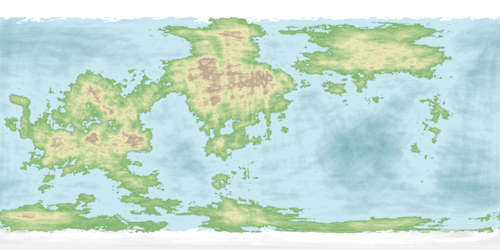
Don’t forget that building your world includes both the physical aspects of the world (where it is in its solar system, how much water compared to land, active plate tectonics, etc) as well as the cultures of the people who inhabit the world. Culture doesn’t form in a vacuum; it is influenced by the space, the weather, the circumstances.

Sample of a Fractal World Generator square map output.

Fractal World Generator square map output

Continue reading Worldbuilding Resources

Speed Writing #11 – 2 AM Snack

The rumbling of my stomach woke me.  I rubbed it, hoping it would stop, then rolled over to glance at the clock.  Fuck.  Two am?  Seriously?  I burrowed back under my blankets, but it was no use.  There was no going back to sleep without a snack.

  As I padded to the kitchen I remembered that because I’d picked up an extra shift, I hadn’t actually been to the grocery store.  I was out of nearly everything.  I could make up some plain pasta with butter and salt, though that had been dinner.  Or maybe heat up a can of green beans.  Yeah.  That wasn’t happening.  I went back to my room for a sweatshirt, and pulled my hair into a messy tail on the back of my head.  As a whim, I decided my nightgown was perhaps a bit too risqué to be traipsing around in on State Street, so I yanked on a pair of long yoga shorts.  They were supposed to be capris but my ungodly long legs made them knickers.  Perfect.  I looked like a crazy disaster, which meant no one would bother me.

Continue reading Speed Writing #11 – 2 AM Snack

Smutty Writer Brain

Brain: Hey, let’s do this prompt.

Me: Really? I’m not sure what to do with this.

Brain: No worries. I’ve got some ideas. Here, see?

Me: Huh. Yeah. That could be interesting.

Brain: And you know, since you’re on vacation and you finished your speed writing, how about we skip the timer.

Me (not sensing the trap): Sounds good. Writing to a prompt is enough of a challenge.

Me: Uh… This is getting kinda long.

Brain: But look at that nice smut.

Me: It is nice. Well I see a good spot to wrap up.

Brain: I suppose we could wrap up there, or…

Me: Or?

Brain: Round two!

Me: Ugh. This has no plot.

Brain: Sure it does.

Me (sternly): Orgasms aren’t plot.

Brain: Says you.


Check out all the Writer Brain shenanigans in reverse chronological order here.

A Peek into the Indie Writer World – Part I: What Does it Mean to be Indie?

If you’re invested in reading books or if you participate in the convention circuit, you may have heard the term “indie writer” gaining popularity. What is an indie writer?

The traditional publishing model generally follows these steps:

  1. Writer gets experience, submitting short work to magazines/websites and longer work to publishers who accept unagented pieces
  2. After acquiring three or more significant or professional publishing credits, the writer finds an agent to represent them (agents generally only manage longer work, such as novellas, novels, and screenplays)
  3. Agent may work with the author on editing their novel or novels
  4. Agent connects with publishers, submitting novels to acquisition editors likely to buy them (the larger the publisher, the more acquisition editors they have)
  5. Once a publisher offers to buy the novel, the agent helps the writer navigate and understand the contract; some aspects may be non-negotiable
  6. The writer receives an advance, this is an advance payment on expected royalties
  7. The publisher may pair the writer with an editor (some houses are cutting this step)
  8. Publishing and distribution is handled by the publisher
  9. The writer receives royalty checks if the work out-earns the advance
  10. The Publisher continues to work with the writer, rejecting stories that aren’t viewed as profitable and directing the writer to marketable stories, until either party finds the relationship a poor fit (though writers and publishers still need to honor the contract if it covers or includes multiple works)

An independent, or indie, writer has decided not to follow the traditional model of publishing. They do the writing, editing, cover selection, publishing, distribution, and marketing themselves. Since it’s critical to have a professional end product, indie writers need to be honest with themselves about what they’re really capable of. It’s a good plan to hire out the parts of this process they don’t have the training or skill set to truly accomplish. Many indie writers hire out the cover art or the book’s layout and design elements.

Print on demand (POD) technology has drastically changed the publishing landscape, evening the playing field for writers who want a different path.  I’ll cover more on how POD and various printing and distribution companies work in the writer’s favor in a future piece in this series.


Check out Part II of this series.

For more articles on writing, check out my Reflections From the Sol section.

Something Familiar – Teaser 6

The sixth chapter of Something Familiar is now available here (along with chapters one through five) for those who need a try before you buy option.

Cover of the novella Something Familiar.

If you read any of the teasers and want to find out more, Something Familiar is available in a variety of formats and from many retailers. You can also check with your favorite bookseller or online store, as it is available outside the US as well.

For those who’ve already bought it, thank you for your support.