A Peek into the Indie Writer World – Part III: Output Options

Once you’ve chosen the indie writer path, you need to decide what products or outputs you want to provide. Common options include print, e‑book, audio book, and online serial. There are advantages and disadvantages to each, and there is no one-size-fits-all approach. Looking at your target audience to see how they prefer their media, and deciding what you can afford to spend on your launch are good starting points. 

Indie publishing doesn’t have to break the bank, but there are some expenses; these will depend on your skill-set and the products you’re creating. Even if you’re able to do all the technical work yourself, you’ll need to buy an International Standard Book Number (ISBN) for each publication or version of a publication. 

Print Run vs Print on Demand 

If you decide you want to offer a print edition of your book, there are still a lot of choices to make. Do you want hardcover or paperback? If paperback, do you want mass market (sometimes called pocketbook) or the larger trade size? Do you want regular print and large print options? Are you going to do a print run or go with print on demand (POD)?

Print Run

In traditional publishing, many copies of a book are printed all at one time. This is a print run. The goal is to sell all or most of the print run. If a book’s print run sells out early enough in its publication life, it will go back for a second printing. Indie writers can duplicate this process, working directly with printing companies to produce hardcover or paperback books, paying for the print run and hoping to sell enough to break even or make a profit. 

An advantage of a print run is that it’s easier to sell something that people can take with them right then and there. There are also some nice finishing features that a print run can make available that don’t exist in print on demand, such as a variety of bindings and maps on the inside front cover and/or endpaper.

Each printed format of the book (hardcover, paperback, large print, etc) requires its own run. If you’re planning multiple print formats, or if you don’t have investors or ready money to cover the outlay, a print run may not be the best fit for you. 

Indie writers who go exclusively with a print run, rely on hand-selling their book at conventions or events, and are directly responsible for all sales. Independent book stores may carry your books on consignment, but it can be very tough to get big chain stores to carry your books outside of their distribution channels.

Print on Demand (POD)

Print on demand is a publishing model where physical books are individually printed as they are ordered. Modern technology has made POD an affordable and common option. If you order a book from an online retailer, and the book is scheduled to take a week or two to arrive, odds are good that it’s POD book. POD printers can provide hardcover and multiple paperback formats.

POD printers often work with both print and e-book outputs. Many have arrangements for distribution to retailers, national and world-wide, which can take some of the burden of selling off the writer’s plate. You must follow designated formatting standards if you want your book to qualify for distribution. This is a detail-focused task that results in a professional product.

Unless you’re buying additional services, POD has a very low cost to the author. You will need to buy a proof of the book, a copy for you to review and make sure it printed properly, before it will be released to the general public. You may need to make changes and order an additional proof to confirm the end product is as expected.

Once you’re happy with the output, you can order your own mini print run of ten or twenty books to hand-sell at readings or events. There’s usually a price break at certain levels, making it worthwhile to buy a larger number, but the per-book price will not be as low as it is with a regular print run.

A disadvantage with POD is that many online retailers have contracts with various printing shops around the country (or even the world), ensuring the book is printed closer to the delivery address. These shops may not have the same quality or standards, and indie writers can’t possibly know how that quality compares. Like a print run, it can be very difficult to get your books carried in brick and mortar stores, but big chain retailers may have them available for online ordering.

E-book

Electronic books, or e-books, are one of the easiest ways to dip your toes into the indie pool. Many e-book providers also offer distribution (sometimes referred to as aggregation). To qualify for wide distribution, your end product will need to meet specific criteria ensuring that it looks professionally produced.

There are many advantages of going the e-book route. It’s relatively simple to set up and produce. Depending on your skill set, and willingness to work through the technical elements, this can cost as little as $25 (the cost for an ISBN). Some e‑book production companies provide a free ISBN; just read the fine print to ensure you aren’t going to regret not being the owner of that number. 

E-books become available relatively quickly, often the same day you complete the publishing process. Because of the low cost of production, these can be priced low enough that curious readers may be willing to take a risk on someone they’ve never read or heard of before.

A disadvantage with e-books is the difficulty in standing out from the deluge of e‑books published daily. While libraries are starting to carry e-books, it’s not universal, making this a tough bottleneck to get through. Not all audiences have embraced e‑books, so it’s critical that you know your audience’s preference.

Audio Book

Audio book is an output I’ve researched significantly but haven’t been able to provide. I have friends with visual disabilities who would benefit, and I know several people who enjoy listening to books on the bus or long car rides.

Like a print run, audio book has more up front expenses than other outputs. You can expect to pay your voice actors at least $200 to $400. If you’re doing your own recording, be careful not to over-estimate your ability or your equipment. Theatrical or voice training can definitely help you out, but they don’t guarantee a successful product. The reading quality and audio quality will make or break your audio book.

Online Serial

Online serial publication is another easy place to start, especially if you can stick to a schedule. It doesn’t require an ISBN, but it does require participation in a service that is set up for subscriptions and donations. If you’re tech savvy enough, perhaps you can program this into your own site. Most writers use something like Patreon or Wattpad.

This route is still relatively new in the industry. The advantage is that writers can more directly connect with their audience. Some writers use this to gain a following, posting short stories and teasers for free to draw people in, while providing subscribers regular chapters and higher level content.

Disadvantages can include difficulty in getting enough traffic, the pressure of providing routine content for subscribers, and random changes in terms of service (a problem Patreon has had several times in the last year). Some writers don’t feel this counts as truly publishing, but if you are providing content to readers, it does fit the definition.

On the surface these options can seem really intimidating. If you’re finding yourself overwhelmed, pick one to focus on at a time. There’s no reason you can’t roll out various editions as you get more comfortable with the formats. Many writers provide only one format, and that’s fine too. Going indie, means you can do what works for you.


For the first article in this series, check out Part I. Or if you’ve just missed the previous article, check out Part II. For the next article, check out Part IV

For more articles on writing, check out my Reflections From the Sol section.

A Peek Into Indie Writer World – Part II: Why Would a Writer go Indie?

There are a number of reasons writers may choose to go indie, and this is a decision I struggled over for a while. I started out firmly entrenched in the traditional model, but found the time frames and gate-keeping dynamic extremely frustrating.

Time Frames

It takes months to hear back on your submissions to agents and editors, and in many cases you may never hear back at all. I’ve recorded response times of nine months and more. In the speculative fiction field, simultaneous submission is not allowed. This means you can’t send the same piece to multiple agents or multiple editors at the same time. They don’t want to compete with each other this directly, but they also don’t have the staff to wade through their slush piles in a truly timely fashion. This puts all the power in the hands of understaffed agents and editors. When I had young children, I was too busy to continue both submitting stories and writing them. I chose to step out from publishing for a while, so I could focus on creating novels.

Gate-Keeping Dynamic

Once my children were a bit older, I prepared to familiarize myself with the publishing landscape. In order to have an impact with your submissions, you need to be sending your work to the right editors and agents at the right time. During my hiatus, markets had closed or merged, and new ones had come into the field.

By this point I had several friends who had been mid-listed or dropped, despite writing fantastic novels and series. I had other friends who managed to keep their contracts by writing what they were told to, rather than what they wanted to. Some writers don’t mind that latter scenario, but in many cases, the pay isn’t high enough for me to want to make this compromise. If I can’t make my living writing what I want to be writing, I don’t want to follow that path.

It took me some time to decide I had no interest in playing the traditional publishing game.

Making a Decision

Indie writing is a lot of work, you become the writer, editor, copy editor, cover artist, layout technician, and publisher. You make the distribution and marketing decisions and then implement them. Both models have their advantages and disadvantages, neither is intrinsically superior to the other.

So how do you determine if indie writing is a path you want to take?

Signs that indie writing might be a good fit include (but are not limited to):

  1. Writing for a smaller audience such as a marginalized community (many larger presses won’t take on projects they don’t see as largely profitable)
  2. Desire to have full creative control over revisions and cover art
  3. Interest in learning or using project management skills
  4. Interest in learning the publishing business from start to finish
  5. Accurate awareness of your skills and your weaknesses
  6. Willingness to hire out the elements you lack the skills or interest in completing
  7. Willingness to engage in marketing endeavors yourself
  8. Willingness to accept a slower build in your readership
  9. Uncomfortable with long response times on submissions and lengthy waits for publication

Signs that indie writing would not be a good fit include:

  1. Desire or interest in handing off your work once the writing is done
  2. Willingness to relinquish revision and creative control decisions to another
  3. Desire to have your books immediately placed in physical stores
  4. Comfortable with long response times on submissions and lengthy waits for publication (one to two years is common)

In both indie and traditional publishing, it stands to reason that you want to be sure you’ve hit a point in your writing development that you are producing high quality work. Your stories need to engage and interest your audience for both models, but it is especially damaging to your credibility if you start releasing unprofessional or poor quality work as an indie writer.


For the first article in this series, check out Part I. For the next in the series, check out Part III.

For more articles on writing, check out my Reflections From the Sol section.

A Peek into the Indie Writer World – Part I: What Does it Mean to be Indie?

If you’re invested in reading books or if you participate in the convention circuit, you may have heard the term “indie writer” gaining popularity. What is an indie writer?

The traditional publishing model generally follows these steps:

  1. Writer gets experience, submitting short work to magazines/websites and longer work to publishers who accept unagented pieces
  2. After acquiring three or more significant or professional publishing credits, the writer finds an agent to represent them (agents generally only manage longer work, such as novellas, novels, and screenplays)
  3. Agent may work with the author on editing their novel or novels
  4. Agent connects with publishers, submitting novels to acquisition editors likely to buy them (the larger the publisher, the more acquisition editors they have)
  5. Once a publisher offers to buy the novel, the agent helps the writer navigate and understand the contract; some aspects may be non-negotiable
  6. The writer receives an advance, this is an advance payment on expected royalties
  7. The publisher may pair the writer with an editor (some houses are cutting this step)
  8. Publishing and distribution is handled by the publisher
  9. The writer receives royalty checks if the work out-earns the advance
  10. The Publisher continues to work with the writer, rejecting stories that aren’t viewed as profitable and directing the writer to marketable stories, until either party finds the relationship a poor fit (though writers and publishers still need to honor the contract if it covers or includes multiple works)

An independent, or indie, writer has decided not to follow the traditional model of publishing. They do the writing, editing, cover selection, publishing, distribution, and marketing themselves. Since it’s critical to have a professional end product, indie writers need to be honest with themselves about what they’re really capable of. It’s a good plan to hire out the parts of this process they don’t have the training or skill set to truly accomplish. Many indie writers hire out the cover art or the book’s layout and design elements.

Print on demand (POD) technology has drastically changed the publishing landscape, evening the playing field for writers who want a different path.  I’ll cover more on how POD and various printing and distribution companies work in the writer’s favor in a future piece in this series.


Check out Part II of this series.

For more articles on writing, check out my Reflections From the Sol section.

Critique – A Look At Process

Critique is an examination of a story’s components and how they work together, in order to identify strengths and weaknesses. The goal is to help the author tell her story in the best way she can. Copy editing, identifying grammatical and structural language problems, isn’t the same as a critique, though critique may include copy editing. Whether you’re new to it or you’re trying to change your process, critique can seem a lot more daunting than it really is.

Most of the critique process is going to happen on your own, as you read the manuscript and record your feedback. There are a lot of right ways to do this, and your process may vary depending on the circumstances. I like to receive detailed in-depth feedback, so that’s what I try to give. I prefer to have a hard copy of the manuscript, and I promise I will scribble on it. I almost never read without a pen in hand, because I may not remember where that missed comma was later. Being able to mark the spots in the story that I want to address is more efficient than having to tell the writer, “the third sentence in paragraph five muddies your dialogue.” This also allows me to mark minor problems, or parts that I really liked, without a lot of extra work. Tracked changes don’t always transfer from one word processor to another, or even to different versions of the same program.  While I like the idea of going paperless, I only use it when I’m critiquing by e-mail, and I prefer to use Google Docs on suggestion mode in those situations.

In my comments, whether written or spoken, I make a point to focus on the writing, not the writer. I would never say, “you’ve obviously never been camping before.” Instead I might note that the camping scene felt artificial or vague, as well as pointing out specific details that are inaccurate. We all have bad days where we sound clueless, even when we’re the leading expert on the subject. Also, it does no good to attack another writer. It hurts feelings, among other things, and it’s the writing you’ve been asked to judge, not the person.  It is as important to point out what worked and what you liked, as it is to point out the flaws. This makes the feedback more palatable while ensuring the writer that they did something right.

Once in a while I’ll be asked to critique something that ends up not working for me. It may be that I’m not the right audience. To counteract this, I remind myself why I’m doing the critique. I review my personal philosophy on critiquing. If I reach a point where I loathe reading the story and can’t point out anything positive, there’s a good chance I don’t get it or I’m not the target audience. Forging ahead with a critique will result in something that won’t help the author; there’s a good chance you’ll come off as harsh and you’ll look like an idiot. I’ve done this once, and I still feel bad about it. Learn from my mistake. If you’re finding lots of negative things and very few positive things, it may be best to bow out of the critique.

I use a three-step approach for most critiques.

Step 1: Read the story and record my first impressions. I’ll also note if I liked the story or not, since this will likely influence the rest of the critique. While I have a pen in hand, I usually only mark copy problems at this point. You can use whatever editing symbols you like, as long as the recipient is going to be able to tell what you mean. In the critique groups I’ve been in, we’ve mostly used Associated Press standard proofreading symbols (which are pretty easy and intuitive, and you can find them with a Google image search).

Step 2: Let the story sit for several days or longer, if possible, before reading it again. I use a different colored pen this time; because I’m likely to make more comments on the manuscript for this round, I usually avoid red. It makes my markup look less scary. While reading, I may make notes that will feed into my formal critique.

Step 3: Write up the critique. This is the formal report with whatever I found worth mentioning. When giving critique in person, I pretty much read what I’ve written. There are two benefits to this. The first is that I already have carefully chosen words when breaking bad news, rather than whatever flies out my mouth. Second, the recipient doesn’t have to take notes on everything I say, and can more actively listen. I made a form for my critiques because it’s more organized than a random essay response, and it reminds me to give feedback in areas I may forget about.

If you’re new at giving critiques, try a few different methods and see what works for you. Think about what you’d like to get back, other than glowing accounts of your brilliance, and structure your feedback in a way that provides guidance to the author. Give yourself plenty of time to review your critique before you give it, so you can adjust your own language to be appropriate. Everyone starts out not knowing how to do this, and with practice it gets better.


The two critique forms I’ve used most often are attached here as downloadable ODT files. Feel free to modify and use these to fit your needs. Most word processors will open ODT, if yours won’t, and you need a different format, please let me know.

Critique Philosophy

Most artists don’t improve and grow without some external input; it’s often tough to identify weaknesses in your own work. Critiques are one of the best ways for artists to improve, because they provide the response of an audience, showing you what didn’t successfully transfer from your internal context to the rest of the world. For writers, one of the best ways to get constructive feedback on your writing, is to agree to provide it in return. This is the foundation for most writers’ groups. Giving critique is an art form in itself, and for many it’s not intuitive. Like anything, it gets easier with practice.

You may wonder if there are benefits to learning how to do critique, other than as an exchange. Plenty of authors don’t care to take the time to develop this set of skills. While it’s true we all go about our art differently, most of us get a pretty significant boost in our writing skills when we collaborate this way. Critiquing others’ work can establish a group of artistic peers. It’s handy to have people who understand you when you’re venting about the publishing business, troubleshooting a story, or want to celebrate a success. You’ll exchange more than just feedback over time; I get a lot of market information from my network of peers. The biggest gain from learning to critique, is mindfulness of writing craft in your own work. This results in increased ability to improve a your own drafts and revisions without external aid.

Going into a critique, it’s a good idea to check your motivations. Is your goal to help someone tell the story they’re aiming for? This is a great starting point. Are you doing it solely to get feedback in return? If so, are you willing to give as good as you expect to get? There are few things worse than a writer who provides four sentences of non-specific feedback on a seven thousand word short story, but expects two pages of formal critique and an hour of detailed discussion on their partial chapter. I’ve been in groups with these people, and it creates unpleasantness. If you’ve gotten feedback you didn’t like or disagreed with from a person whose work you are critiquing, you need to find a way to let go of any petty hurt feelings so you can approach their piece objectively. Spite critiques suck. I’ve gotten these, and they make you look like a spoiled child. If you don’t thing you can be objective, request an extension or recuse yourself.

If your goal is to hurt feelings, tear other writers down, or make yourself feel superior, you’re doing it wrong. Critiquing isn’t about toughening up your fellow writers, though there are writers and workshops that play this card. Writing and self confidence use different skills without significant crossover. Claiming you’re just trying to help, while reducing a fellow writer to tears or rage is both abusive and a big fat lie.

At the core of your critique process, you need to have respect, both for the writer and the effort they’re making to improve. It’s a vulnerable position to be in, allowing someone to find all the problems in your stories, the problems with your writing. Done right, the benefits are enormous on both sides of the coin.


The two critique forms I’ve used most often are attached here as downloadable ODT files. Feel free to modify and use these to fit your needs. Most word processors will open ODT, if yours won’t, and you need a different format, please let me know.

Writing With the Dragon: A Voice Recognition Primer

So you’re a writer, and you’ve heard about voice recognition software. Perhaps you’re considering using it, because it sounds like a pretty nifty invention. Then again, you may have maimed yourself along the way and need alternative ways to get your stories out of your head and onto paper.

Most people who get as far as trying out voice recognition software are either curious or desperate. If you’re curious, you can probably skip ahead to the next paragraph. If you’re in the desperate category, as I once was, I can already hear the arguments forming. “Voice recognition? No way! I think with my fingers, not with my mouth.” Many writers get apoplectic when you even suggest the smallest modification to their routine. Hogwash, I say. The human species is incredibly adaptable, and the muse will not leave you simply because you have changed your ways. It’s plain stupid, not brave, to put up with and add to your pain when there are options. Trust me on this, I’ve been plenty stupid and wasted a lot of time not being able to write, which turns me into an unhappy, nasty, insomniac.

There are a lot of things to keep in mind when considering voice recognition software. I use Dragon NaturallySpeaking, but most of these tips are applicable to any recognition program.

Modify your expectations – it won’t be perfect, especially not right away.

Many people expect voice recognition software to be absolutely perfect from the get go and are then quite disappointed by the results. You will have to spend some time training the program to recognize your voice before you can even start to use the software. Initial training isn’t difficult or time consuming; these days it can be completed in as little as five to ten minutes. Since no two people pronounce everything exactly the same, the program has to tailor itself to the individual voice, so each user has their own profile. A good program will continue to learn and adapt after the initial training as the voice profile is used and corrections are made. I don’t expect my current software to recognize me with 100% accuracy. Maybe some of the upgrades down the way will, but until then, I expect to make corrections during my dictation, and with practice there have been fewer. Despite the need for occasional corrections, it is still faster than I used to type on a good day. Again, don’t expect to be fast right away. Remember, learning curve.

Train yourself, not just the software

Historically, speech has not been my preferred option for communication.  In using Dragon, I’ve had to train myself to speak properly. I’ve learned to enunciate, at least when I’m dictating. I’ve also learned to speak stories in complete sentences. This may sound frighteningly basic, but for those of us who are biologically wired to create via the written word, speaking a story is a new and clumsy process. Story tellers and story writers are not the same thing.

The first story I wrote with Dragon was an exercise in academic torture. Each sentence and phrase came out about three words at a time with great long pauses in between as I tried to figure out what I was doing. I’ve never had to think so hard when writing before, or since. Dragon NaturallySpeaking is designed to recognize natural speech, so you don’t need to talk slower than usual. The software uses context for selecting the proper homonym. It also uses context to attempt to catch misrecognition so you don’t have to make as many corrections. My slow and stilted style from the first few months gave the Dragon quite a challenge.

While you may not have the ideal set up, get as close to ideal as possible.

If your system comes out on the low end during the initial sound test, double check the microphone. How far is it from your mouth? Adjust it, and try again. Placement can make a significant difference. Are you talking into the right side of the microphone? Mine was rotated about 45 degrees off for the first six months or so, and since it recognized my speech with reasonable accuracy I didn’t check it for a long time. The recognition improved a lot with proper orientation. Also make sure you’re plugged into the right jacks on the computer. Most newer computers don’t give you a lot of options in this department, and sockets and plugs tend to be nicely color coded.

I’m using Dragon NaturallySpeaking Preferred version 10. Processor speed and memory are the two most significant factors and hard drive space is less of an issue these days, although voice files can get pretty big. I also started out with the freebie microphone that came with the software, but upgraded to an Andrea USB microphone with built in sound card. The advantage is that its sound card is designed solely for speech, while a regular sound card has to try to manage everything from video games to symphonies, resulting in lower quality speech processing.

I use Dragon in LibreOffice Writer, though it’s not fully compatible. I can run basic commands, but can’t control the entire word processor by voice. If I wanted to use Microsoft Word (which I really, really don’t), it would allegedly be fully compatible.  I’ll also use the built in Dragon Pad and copy/paste everything over to Writer when I’m done with the session.

Know when to save. 

Every time I close Dragon, it asks if I want to save the changes to my voice files. If I say no, any corrections I made to misrecognized words or new words and names that I taught it during the session will not be added to the voice profile. Generally you want to save your voice files as often as possible. I also keep an offsite backup since I’ve trained the software to recognize a number of unusual, foreign, and science fiction specific words. If I have a sore throat, stuffy nose, or a cold, I don’t save my voice files. I’ve not gotten around to creating a profile for my sick/asthma writing days, but this is a good option, particularly when you have an ailment that tends to linger or come up routinely.

Don’t give up. 

I would never say that it is easy to learn to use this software, and I constantly challenge people who claim it is. But it’s not impossible. People who naturally think in a spoken form will have an easier time of it. Expect to correct errors (and remember that it’s not always the fault of the program). Rewiring your brain takes time, but it’s good for you.

Tips for Starting Out

  • To prevent voice strain, always have something to drink on hand, and actually drink it. I use a straw so I don’t have to keep adjusting the microphone. Don’t try to speak unusually loudly or quietly, and take breaks.
  • When first starting out, do it when no one else is home. You’ll feel less like someone is reading over your shoulder.
  • Limit external noises such as music or fans. I’ve found that Dragon gets annoyed when my dogs bark.
  • Don’t dictate right after eating, especially if you have had chocolate or dairy products which can coat the vocal cords. Gargling with salt water or drinking grapefruit juice sometimes helps.
  • Let yourself be amused. If Dragon makes a mistake, laugh. It’s not the end of the world.
  • Do not bite your microphone when you get mad at misrecognition; it hurts.

Other notes:


Dragon NaturallySpeaking recognizes two forms of speech. Natural speech for when you are dictating, and command speech for your instructions to the program. Commands work best when issued separate from dictation. You will develop a command tone of voice.

Some of my favorite Dragon commands include:

  • “What can I say?” To provide a listing of verbal commands
  • “Correct that” To bring up a correction box for the the last chunk of text dictated
  • “Scratch that” To remove the last chunk of text dictated from the document
  • “Go to sleep” To turn off your microphone until you use the “wake-up” command
  • “Click file save” Which will give you the file drop-down menu followed by a virtual click on save.

Some of my favorite Dragonisms (errors in recognition) are posted on this page (cause this one was getting too long). It’s good for a laugh.

Me and My Sci-Fi Chair

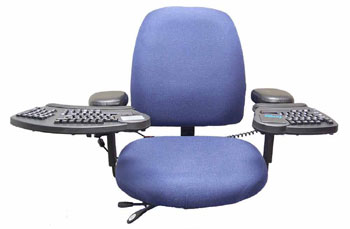
My office looks like the command center of a space ship. A low budget space ship with a clutter problem, perhaps, but futuristic nonetheless. Many years ago I banished my cheap ergonomic keyboard and kitchen chair and replaced them with a keyboard system.

I literally waited for this keyboard for years. I tested out a prototype in physical therapy in 1995 (not a typo, I’m that old), and after a few moments of typing I knew that I had found my soul mate. Ok. So it doesn’t exactly have a soul, but it’s definitely one of the first things I’d grab in an emergency of the house destruction kind. Unfortunately, as a newly developed device, it was also in a price range that made it unobtainable to a recent college grad and new homeowner. So I waited.

Sometime after I tested the prototype, the keyboard developers joined forces with a chair manufacturer and released it as a combined system known as Interfaces by Cramer. After a while Interfaces was bought by Kinesis and they renamed the keyboard Evolution. Kineses made a desktop model, an under desk arm suspended model, and the chair mounting model.

The Interfaces/Evolution keyboard is a truly split keyboard, not this halfway stuff you find in a standard ergo keyboard, it’s often referred to as a floating keyboard. Half of the keyboard attaches to the right armrest of my chair and the other half attaches to the left armrest. I can put my feet up on the desk and still type, if I were inclined. I’m not. But I could if I wanted to. There’s an integrated track pad, I opted for the left hand version after discovering that you couldn’t get it on both sides (eventually there was a model that had it on both sides). Each armrest is adjustable, and each section of the keyboard will raise, lower, pivot or tilt to the position most comfortable to the user. A not insignificant percentage of the population can’t comfortably pronate their hands (that’s the palm-down position necessary with most keyboards). For everyone else, it’s still a good idea to change your position from time to time. My system allows for all of that.

The chair was a bit of an unexpected boon. I’d always ignored my seating arrangement when writing. At one time I didn’t have a chair at all; the computer was only a foot or two off the floor on a couple of milk crates, so there wasn’t room for a chair. This wasn’t ideal for my back, or so I was told after I developed a pinched nerve. The kitchen chair was better, but what the heck is lumbar support, anyway? Most office chairs I’ve used aren’t suited for six-foot tall people with absurdly long legs. Whatever.

Now when I sit down to write, I am in control. I am the commander of all I see (at least until the computer crashes, proving who’s really in charge). I get delusions of grandeur. I can really put myself on those spaceships I occasionally write about. Who better to enjoy this technological masterpiece than a sci-fi writer? The real bonus, of course, is that I can type for longer periods of time without my arms threatening to secede from the union of me. This is critical because I still do all my editing by keyboard.

Granted it isn’t all roses. This split keyboard took some getting used to. It probably didn’t help that I taught myself to type and didn’t use the right fingers for anything (what is this “home row” you speak of?). It’s a long way to reach for a key on the other side of the board. When I first got started, I often had to watch one hand to make sure it was doing what it ought. It was initially really tough to alternate between the god of keyboards at home and the regular old ergo I use at my paying job. The keyboard and chair take up a lot more space than you’d expect, and I have to be careful not to smack the keyboard against the desk when I turn. 

The most unfortunate thing, however, is that ultimately Kinesis decided the Evolution just wasn’t popular enough and discontinued it. You can sometimes find a used one for sale on E-Bay or Craig’s List; I actually picked up a second one a few years ago this way. I look into it periodically, and so far no one is making anything quite like this, and I fear its eventual demise.

Its nice to enjoy some of the benefits of technology I write about and dream about from time to time. A lot of them could be closer that we realize, but in a capitalist economy, the price point and sales figures may make them quickly obsolete.

Data Loss

Note: while I reference writers here, this applies to many other artists who produce projects that can be stored in a digital format (music, visual, film, etc).


The writer has a multitude of fears. For non-writers this statement may conjure a general list including failure, rejection, creative blocks, and not being taken seriously. While these may indeed cause some concern for a writer, they are nothing compared to the king of all fears, data loss. Some of us live blissfully in denial, unaware how terrifying it is, until we experience it.

The loss of stories, research, and supporting documentation comes in many forms, flood, fire, burglary, but the most common is a computer failure of some sort. The computer is an essential tool for most writers. Computers, like all machines, eventually wear out. Any machine can have a defective part, causing a malfunction at any point during use. If your machine is portable and travels with you, the risk of damage or theft increases. So where does that leave the writer when the parts go bad and the machine fails?

Your actions will determine if this is an inconvenience or Shakespearean-level tragedy.

Save early, save often; it’s a maxim that has stuck with us since the early days of personal computers. Often this means saving to the hard drive in case you lose power or the program experiences a random error. After all this time, autosave still kind of sucks. But just how reliable is that thing that makes all those whirring noises when you open and save files? Hard drives are a lot less touchy than they once were, but it’s still not a question of if your hard drive will fail, but a question of when.

Saving to the hard drive alone isn’t enough. Fortunately, there are a number of ways to back up your data, with network, USB drive, CD/DVD, and cloud being pretty popular. How often should we to time out of our writing schedules to make these important back ups? Daily? Weekly? Monthly? If not done often enough, you’ll lose some of your changes, or maybe your newest projects when your hard drive screeches to a halt. We each have to decide how much loss we can live with, and then pick a process we’ll actually follow through with. Having the plan and not using it will just make you hate yourself all the more when someone breaks into your house and takes your computer. Let’s try to avoid the self-loathing, shall we?

A historian friend of mine introduced me to the acronym LOCKSS – lots of copies keeps stuff safe. I’ve used this to develop my backup process. Every time I write, I back up my work on a USB drive that goes everywhere with me. I have an in-home network that I back up to as well, though not as frequently as I could, mostly because it’s currently a manual process. Periodically, I save to an external hard drive that I hand off to my parents, who live in a different city.  In the last year, I started monthly backups to a cloud drive.

Remember, if your backup plan is too complex or too time consuming, you won’t actually do it. And if you don’t actually do it, we’re back to the self loathing.

Save early, save often, and find a back up method that meets your loss threshold and realistic willingness to put forth effort. When your hard drive makes clicking noises sounding like a very slow turn signal, I hope you can sigh with resignation instead of sobbing with despair.  I’ve done both, and the one is infinitely preferred over the other.

Let’s Talk Dialogue

Dialogue can be one of the key structural components to a story, and there’s a lot of vague recommendations and misinformation regarding it. This is one of my writing strengths, and I’ve given it a lot of thought while helping other other writers use it effectively.

Purpose
There are a fair number of writers and writing instructors who insist dialogue has only two functions, moving the plot forward or developing the character.  I very strongly argue that this is an oversimplification, and misses several ways dialogue can serve a story.  In addition to these, well-written dialogue can ramp up or defuse tension, develop the world, contribute to description, and break up long narrative passages.

It’s hard to invest in characters and a conflict or argument they’re having, if you don’t see how it starts or how it is perpetuated through the characters’ actions and speech.  How a character speaks tells a lot about how they’re feeling about a situation or another character.  Rather than telling the reader that a character is awkward, nervous, or confident, you can show it with their word choices and the tags that support their speech.  It’s much more satisfying and visceral.

What your characters say to themselves and others tells the reader about the world, about the culture, and about what they are seeing.  The language you choose to use, can tell the reader that the atmosphere is casual or formal.

Quantity
There is no holy grail formula for determining the perfect amount of dialogue for all stories.  There are stories that work perfectly fine with no dialogue, though this is much less likely to work in a novel.  There are excellent stories and chapters that are almost entirely dialogue.  The key is to make sure that the dialogue, or lack thereof, fits the story.  

If what you’ve used provides the story with additional depth, it’s what you need.  If it feels extraneous or leads the story or reader off on undesirable tangents, it needs to be cut or revised.

Placement
Like any writing tool, dialogue needs to fall into the correct place in the story.  Misplaced dialogue is jarring, pulling your reader out of the story.  The content of the dialogue needs to be reasonable, and follow the logic of your characters.  This is something many writers have trouble with. They focus so much on using dialogue to push the plot that they throw in conversations that would never happen where or when they do.  Or they force the dialogue along a path that doesn’t make sense.  While it’s true real conversations don’t always logically go from point A, to point B, to point C, there needs to be some connection, some reason if your character is going to switch from talking about the weather to screaming about past injustices.  If there’s no connection, it feels artificial, and it needs to go.  If the conversation needs to get to a certain point, make sure the writing beforehand, or the internal narration during, lead us there logically.

Language
The language used in your dialogue can tell the reader a lot about the characters and the setting.  Word choices tell us if the characters are comfortable with each other, if they see eye-to-eye, or if they’re nervous.  They show us that the setting is formal or informal through the use of social cues and structure.  The words used by a character can tell the reader about their upbringing or past.  Do they say soda or pop?  Fireflies or lightning bugs.  Some of these are subtle, but all feed into the construction of your character.

Some instructors loathe contractions and insist they don’t belong in dialogue.  They are mistaken.  If the situation is formal, then it’s true your character may not use them.  If the character is not a native speaker of the language, they may not use contractions either. But a native speaker not using contractions when chatting at home or on the phone with their best friend feels stilted and fake.

I recommend caution when using vernacular, or phonetic representation of a dialect or accent.  Mark Twain was a master of this, and most of the rest of us just aren’t.  I’ve read a fantasy series where some characters speak with a Scottish brogue. Despite my familiarity with it, I have to speak the dialogue out loud in order to understand some of what they’re saying. This pulls me out of the story. Patois is perfectly understandable to my ear, but nearly impossible for me to read.  It’s not that this tool is unusable, it just needs to be used cautiously.  One of the reasons Twain was so good at it, was that he dialed the vernacular back, giving just enough to provide the world setting flavor without losing the reader.  

Test It
One of the best ways to determine for yourself if your dialogue is working, is to read it out loud. Does it sound like a real person? Does it sound like something the character would say, or does it sound like another character?  Read the entire story out loud. If the dialogue feels like it’s slowing the story or doesn’t flow, then it’s too long or misplaced.  If it feels natural and moves the story or its architecture (characters, world or plot), then it’s perfect.

Last Thoughts
Like character development, dialogue will add word count and page length. If additional length is a problem, you can truncate or summarize parts of longer conversations, particularly the parts that don’t significantly add to the story.

The Benefits of Writing Tech

I grew up as a writer, it was the one thing I was always comfortable with. As a kid, I claimed I was going to be a pharmacist, just like my dad. But he’d seen my math scores and knew better.

My earliest stories were written in pencil or pen in spiral notebooks. I had atrocious handwriting. Still do, actually. My dad gave me his college typewriter when I was ten, and suddenly my writing gained new clarity. The typewriter was probably twice my age, and it was one of those cheap models with no frills. Frills such as an exclamation point or the number 1. It had no correction ribbon, and whiteout became my new best friend. If I typed too fast the keys would stick together. The carriage return was completely manual. The shift key lifted up the whole carriage with a heavy clank, dropping it twice as loud. My skinny little fingers would sometimes get stuck between the keys, and when I look at it now I wonder that my ten-year old hands were able to bang away for hours at the thing.

The affordable home computer changed the world of writing forever, at least until we have a zombie/plague/asteroid apocalypse. Writers can now concentrate on creating rather than the agony of retyping their five-hundred page masterpiece for the sixteenth time because they’ve made some revisions. Typos are easy to fix. We have the luxury of cut and paste, spell check, and a printer conveniently located in our residence. Many of today’s writers didn’t have to endure the pre and early techno days. Others have locked these memories away behind a tightly locked door with a sign that says do not open until Armageddon. Well, except for Stephen King, who appears to have a fondness for Underwood typewriters.

It’s good to reflect on the changes in the past thirty or forty years simply because it is our heritage as writers. How can we know where we’re going, if we don’t know where we’ve been or how far we’ve come? And it’s good to remind ourselves, when we’ve got a virus or our hard drive has crashed, that there was a time when we didn’t have it so easy.

Early word processors, the dinosaurs, were an improvement over manual typing, simply because you could save your work. My first word processor was called Magic Desk, and it was a cartridge for the Commodore 64. I had to save each page separately. Cut and paste didn’t exist. The five-inch floppies were difficult to take care of, and disk cases were out of my price range. There was no saving to the hard drive in those days. Spell check involved keeping Webster’s close at hand.

Then there came such advancements as Word Star and Word Perfect, the DOS versions. Hitting the wrong key combination could be devastating in those days. What you saw on the screen was not necessarily what you got on printout, but there were a bundle of new features in this state of the art hardware and software. There would be no more manual underlining for me. Insert and type-over were a sheer delight, once I’d figured out which was which. And the cut and paste features were beyond my expectations. I met my first spell checker, and it was good.

With today’s word processors, the art of writing has become streamlined. We’ve removed some of the tedious and unpleasant tasks associated with editing and revising, other than working with the words themselves. We’re no longer required to have perfect spelling, though homonyms are still problematic and grammar checkers continue to suck. We have voice recognition software for those who have difficulty with typing. There are programs specifically designed for writers that help you organize your character, world, and plot details. Publishing continues to work through its massive upheaval, with electronic and print on demand options opening doors for a lot of writers who had no chance with the traditional model (and not because they’re bad writers).

Despite all these advancements, it is still essential for a writer to have a grasp of the language she writes in, or she’ll fail to tell the story she intends to. We still need to practice and hone our craft, trying new things and stretching once in a while to create things that are new and interesting. No matter how sophisticated the programming, technology alone will not make you a writer. It can only aid you in getting the job done. Writing itself has not necessarily gotten easier, even if the peripheral aspects have. That which is truly worthwhile is rarely ever easy, though it’s nice to be able to focus on the words and the story more than the mechanism for recording them.