
Critique – A Look At Process

Critique is an examination of a story’s components and how they work together, in order to identify strengths and weaknesses. The goal is to help the author tell her story in the best way she can. Copy editing, identifying grammatical and structural language problems, isn’t the same as a critique, though critique may include copy editing. Whether you’re new to it or you’re trying to change your process, critique can seem a lot more daunting than it really is.

Most of the critique process is going to happen on your own, as you read the manuscript and record your feedback. There are a lot of right ways to do this, and your process may vary depending on the circumstances. I like to receive detailed in-depth feedback, so that’s what I try to give. I prefer to have a hard copy of the manuscript, and I promise I will scribble on it. I almost never read without a pen in hand, because I may not remember where that missed comma was later. Being able to mark the spots in the story that I want to address is more efficient than having to tell the writer, “the third sentence in paragraph five muddies your dialogue.” This also allows me to mark minor problems, or parts that I really liked, without a lot of extra work. Tracked changes don’t always transfer from one word processor to another, or even to different versions of the same program.  While I like the idea of going paperless, I only use it when I’m critiquing by e-mail, and I prefer to use Google Docs on suggestion mode in those situations.

In my comments, whether written or spoken, I make a point to focus on the writing, not the writer. I would never say, “you’ve obviously never been camping before.” Instead I might note that the camping scene felt artificial or vague, as well as pointing out specific details that are inaccurate. We all have bad days where we sound clueless, even when we’re the leading expert on the subject. Also, it does no good to attack another writer. It hurts feelings, among other things, and it’s the writing you’ve been asked to judge, not the person.  It is as important to point out what worked and what you liked, as it is to point out the flaws. This makes the feedback more palatable while ensuring the writer that they did something right.

Once in a while I’ll be asked to critique something that ends up not working for me. It may be that I’m not the right audience. To counteract this, I remind myself why I’m doing the critique. I review my personal philosophy on critiquing. If I reach a point where I loathe reading the story and can’t point out anything positive, there’s a good chance I don’t get it or I’m not the target audience. Forging ahead with a critique will result in something that won’t help the author; there’s a good chance you’ll come off as harsh and you’ll look like an idiot. I’ve done this once, and I still feel bad about it. Learn from my mistake. If you’re finding lots of negative things and very few positive things, it may be best to bow out of the critique.

I use a three-step approach for most critiques.

Step 1: Read the story and record my first impressions. I’ll also note if I liked the story or not, since this will likely influence the rest of the critique. While I have a pen in hand, I usually only mark copy problems at this point. You can use whatever editing symbols you like, as long as the recipient is going to be able to tell what you mean. In the critique groups I’ve been in, we’ve mostly used Associated Press standard proofreading symbols (which are pretty easy and intuitive, and you can find them with a Google image search).

Step 2: Let the story sit for several days or longer, if possible, before reading it again. I use a different colored pen this time; because I’m likely to make more comments on the manuscript for this round, I usually avoid red. It makes my markup look less scary. While reading, I may make notes that will feed into my formal critique.

Step 3: Write up the critique. This is the formal report with whatever I found worth mentioning. When giving critique in person, I pretty much read what I’ve written. There are two benefits to this. The first is that I already have carefully chosen words when breaking bad news, rather than whatever flies out my mouth. Second, the recipient doesn’t have to take notes on everything I say, and can more actively listen. I made a form for my critiques because it’s more organized than a random essay response, and it reminds me to give feedback in areas I may forget about.

If you’re new at giving critiques, try a few different methods and see what works for you. Think about what you’d like to get back, other than glowing accounts of your brilliance, and structure your feedback in a way that provides guidance to the author. Give yourself plenty of time to review your critique before you give it, so you can adjust your own language to be appropriate. Everyone starts out not knowing how to do this, and with practice it gets better.


The two critique forms I’ve used most often are attached here as downloadable ODT files. Feel free to modify and use these to fit your needs. Most word processors will open ODT, if yours won’t, and you need a different format, please let me know.

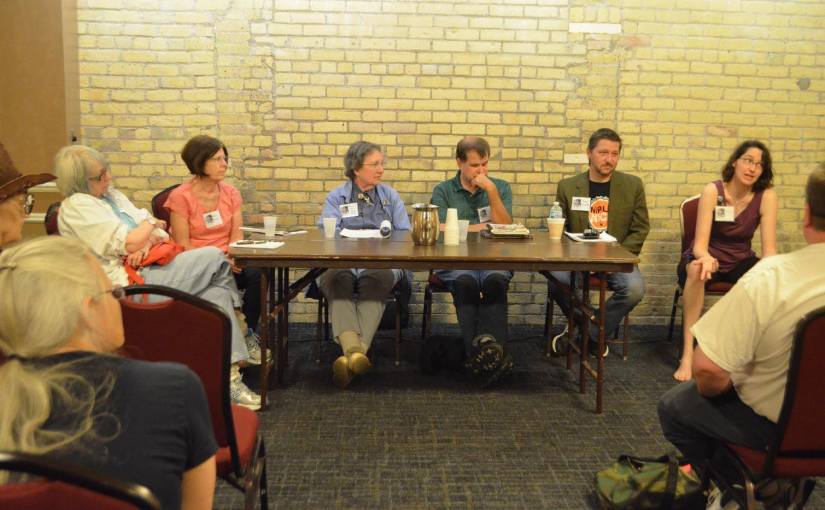
Writing the Other (Diversicon 2019)

Writing the other involves creating characters who differ from us (ethnicity, gender, sexual preference, age, personal philosophy, etc). When writers don’t take the time to research and think this through, it can come off artificial and supports stereotypes rather than contributing to the work’s diversity.

In written works, skin color is overvalued as a difference, and tends to be described in great detail when the character isn’t white (socially emphasized as the norm or primary color in the US).

Comparing the skin of people of color with food (she had a cafe au lait complexion, her dark chocolate hand, etc) can be a way of othering the characters, making them less human than the characters who don’t get compared to food.  Are they people or something to consume? This method of description is almost never used with white characters.  
She stood in the sun, her cheeks like silken tofu, as she waited for her Uber.
Her hand, the rich color of peeled garlic held him back.
Mayonnaise boy quickly joined the group. 

While it’s true some writers will describe white characters as having creamy or milky skin, it’s not the norm to even note white character’s colors, as they are seen as the default. The connotations are also very different when a person in a position of social power or privilege granted  by skin color does this to someone who is often othered.


Writing the Other is both a book and a class for writers developed by Nisi Shawl and Cynthia Ward.

Including diversity in sensitive ways can contribute to the richness of a work, and should be encouraged.  However writers need to plan to avoid the pitfalls and things that can go very wrong.

Critique Philosophy

Most artists don’t improve and grow without some external input; it’s often tough to identify weaknesses in your own work. Critiques are one of the best ways for artists to improve, because they provide the response of an audience, showing you what didn’t successfully transfer from your internal context to the rest of the world. For writers, one of the best ways to get constructive feedback on your writing, is to agree to provide it in return. This is the foundation for most writers’ groups. Giving critique is an art form in itself, and for many it’s not intuitive. Like anything, it gets easier with practice.

You may wonder if there are benefits to learning how to do critique, other than as an exchange. Plenty of authors don’t care to take the time to develop this set of skills. While it’s true we all go about our art differently, most of us get a pretty significant boost in our writing skills when we collaborate this way. Critiquing others’ work can establish a group of artistic peers. It’s handy to have people who understand you when you’re venting about the publishing business, troubleshooting a story, or want to celebrate a success. You’ll exchange more than just feedback over time; I get a lot of market information from my network of peers. The biggest gain from learning to critique, is mindfulness of writing craft in your own work. This results in increased ability to improve a your own drafts and revisions without external aid.

Going into a critique, it’s a good idea to check your motivations. Is your goal to help someone tell the story they’re aiming for? This is a great starting point. Are you doing it solely to get feedback in return? If so, are you willing to give as good as you expect to get? There are few things worse than a writer who provides four sentences of non-specific feedback on a seven thousand word short story, but expects two pages of formal critique and an hour of detailed discussion on their partial chapter. I’ve been in groups with these people, and it creates unpleasantness. If you’ve gotten feedback you didn’t like or disagreed with from a person whose work you are critiquing, you need to find a way to let go of any petty hurt feelings so you can approach their piece objectively. Spite critiques suck. I’ve gotten these, and they make you look like a spoiled child. If you don’t thing you can be objective, request an extension or recuse yourself.

If your goal is to hurt feelings, tear other writers down, or make yourself feel superior, you’re doing it wrong. Critiquing isn’t about toughening up your fellow writers, though there are writers and workshops that play this card. Writing and self confidence use different skills without significant crossover. Claiming you’re just trying to help, while reducing a fellow writer to tears or rage is both abusive and a big fat lie.

At the core of your critique process, you need to have respect, both for the writer and the effort they’re making to improve. It’s a vulnerable position to be in, allowing someone to find all the problems in your stories, the problems with your writing. Done right, the benefits are enormous on both sides of the coin.


The two critique forms I’ve used most often are attached here as downloadable ODT files. Feel free to modify and use these to fit your needs. Most word processors will open ODT, if yours won’t, and you need a different format, please let me know.

Diversicon 2019

I’ll be attending Diversicon, a cozy speculative fiction convention July 26-28. This year’s theme is “The Next Step.”

This year’s guest of honor is Nisi Shawl, a Tiptree-award-winning author who excels at teaching speculative fiction writers about how we can reflect real world diversity in our work.

The special guest this year is Ben Huset, a photographer and life-long advocate of science and space travel.

My Programming

I will be moderating seven panels over the course of the convention (and I’m prepping for those right now). Given the size of the panels and the convention, most of these will likely be more along the lines of structured conversations.

Friday, July 26

4:00-4:55 p.m. – Editors and Authors
S.N. Arly, mod.: Nisi Shawl

5:00-5:55 p.m. Good Blog/Bad Blog–Modern Technology and
Artists.
S.N. Arly, mod.; Conrad Zero

8:30-9:25 p.m. A Peek Into the Indie Writer World
S.N. Arly, mod.; Conrad Zero

Saturday, July 27

Noon-12:55 p.m. Not My Beautiful Minnesota!
S.N. Arly, mod.; Brian K. Perry, Conrad Zero

1:00-1:55 p.m. Resources for Spec Fic Writers
S.N. Arly, mod.; Conrad Zero

3:00-3:55 p.m. Critique Groups–Functional and Dysfunctional
S. N. Arly, mod.; Brian K. Perry, Conrad Zero. 

Sunday, July 28

Noon-12:55 p.m. Preparing for Readings
S.N. Arly, mod.; Conrad Zero

4th Street Fantasy 2019 – Day 1 (Friday)

4th Street Fantasy is held in St. Louis Park, just to the west of Minneapolis.
Check out my Overview post for my first impression and the basics of this convention.

Panel #1 – Fantasy About Everyday People

This was an excellent conversation on the use of the everyday people of fantasy stories. Panelists discussed the Western obsession with monarchs, true bloodlines, and the chosen one.

Panelists noted that having an ordinary person as a protagonist can change things up a bit in an interesting way. Instead of falling into the trap of constantly needing to raise the stakes until they become absurdly high and you just have to end the whole mess, your character could have very meaningful but more localized goals. Saving a community, a friendship, a family member who is in trouble, can all be satisfying. In fact, YA tends to go with these options more often than the goal of saving the entire world.

The mindset that magic and fantasy has to include or rely on a monarchy was noted to be toxic and limiting. Audiences need variety, and regular people (who most of us are) need to see how they can fit into the dynamic of making the world better.

Character development is critical in this type of story, and a rich world can help keep the audience engaged until the plot is sufficient to keep them hooked.

Good questions that writers should be considering at the outset or planning phase:

  • Why not choose the common person for their point of view character this time?
  • What happens to character development and the story arc when the protagonist is a regular person?
  • Can a common person go out and have an adventure or save the world and still be common when they come back, or will they morph into the hero?
  • Can this be written in a way that’s satisfying to read?
  • Is it easier to maintain a character’s ordinaryness in a short story?

I’m personally a huge fan of ordinary people reacting in an extraordinary way in response to a significant event or circumstance. And unlike some of the panelists, I fully believe that the everyday person who goes out and has an adventure can still be an everyday person. Samwise Gamgee went out and saved the world. When he returned to Hobbiton, he stayed on as Frodo’s gardener and caretaker. Being heroic didn’t take away his intrinsic nature.

Dinner at Roti’s Mediterranean

We had dinner at a place nearby that could accommodate a wide range of diets and food intolerances. It was a lot like Naf Naf. If you’ve never heard of either, it’s basically a Chipotle style restaurant with limited items, but assembled in front of you. In this case as a rice bowl or stuffed pita. The falafel was good.

Panel #2 – The Use or Presence of Gods in Fantasy

On this panel it was noted that many gods in fantasy settings aren’t treated with reverence. It was suggested that this may be because so many writers are atheist.

Panelists discussed situations where they felt the gods were more than aesthetic window dressing. Gods can be vast, powerful, and strange (sometimes alien and incomprehensible), who only select characters can interact with. Useful gods are those who explain aspects of the world the characters can’t understand, the ones who provide social order. Interesting gods may be reserved and disquieting.

When fictional gods are more connected to and involved in the world, the author has to work to explain why they don’t get involved and fix problems. It was noted that gods often help fulfill the second stage/act of Campbell’s monomyth.

Questions for writers to consider when including religion in their fantasy:

  • Is there value or usefulness in allegory or dressing up real religions in fiction?
  • How do you avoid this becoming appropriation?
  • Why do we include gods in fantasy worlds? What purpose do goods serve in fantasy?

4th Street Fantasy 2019 – An Overview

4th Street Fantasy is held in St. Louis Park, just to the west of Minneapolis. The hotel has plenty of parking, and the space designated for the con is about the perfect size and arrangement for the roughly 200-person event. The programming room has enough seats and doesn’t feel crowded when nearly everyone is there. The con suite was stocked with a nice mix of treats and healthy food. There’s nice space to take a moment out for yourself, visit with others, or hold a meetup. There are a number of restaurants within close walking distance.

This was very different from any other convention I’ve attended in that it only has one track of programming. It’s common for convention programming to have time slots that don’t have anything of interest to me, and I worried I’d feel cheated out of opportunity if I wasn’t interested in the one panel running at a given time. This ended up not being so much of an issue, and I ended up attending every panel. The programming tends to be much more academic and intellectual than you’ll find at other conventions, even when covering the same topics. With this setup, it was more like the entire convention was sharing a unified dialogue, focused and directed by the programming.

During panels, volunteers ran microphones to audience members with questions, comments, and asterisks. An asterisk is the opportunity to interrupt an entire panel to make a factual correction or request clarification. There are also volunteers who document all the panelist- and audience-referenced books, television shows, and films on a giant flip-chart. There’s a second flip-chart for comments or tangents deemed “that’s a different panel.” The last panel of the convention is taken from this list, either based on frequency of appearance or how well it fits with the overall conversation of the convention.

4th Street schedules generous meal breaks, great for meetups and to let the brain chill after an hour or two of intensity. The con features a friendly and welcoming atmosphere, a communal feel, and a healthy dose of spontaneity. This convention takes inclusion and accommodating to a level I’ve not seen before.

This was my first 4th Street, and I’m definitely planning on returning in 2020.

Something Familiar Now Out in Trade Paperback

You can now pick up Something Familiar in a variety of formats from a variety of sources:
Lulu ePub and trade paperback
iBookstore
Barnes & Noble Nook and trade paperback
Amazon Kindle and trade paperback
Rakuten Kobo (ePub)

If you read and enjoy Something Familiar, it would be amazing if you could put up a review (at whatever site you prefer), as it will help me reach a wider audience.

Cover of the novella Something Familiar.

4th Street Fantasy Convention

I’ll be attending my first 4th Street Fantasy Convention this coming weekend. It’s always sounded like a potentially interesting time, but it’s out of my limited driving range. Fortunately, fellow author Dana Baird has offered to let me ride with her.

This is an intimate conversational convention focusing on creating fantasy art and fiction, and I hope to come home ready for my next big plan.